
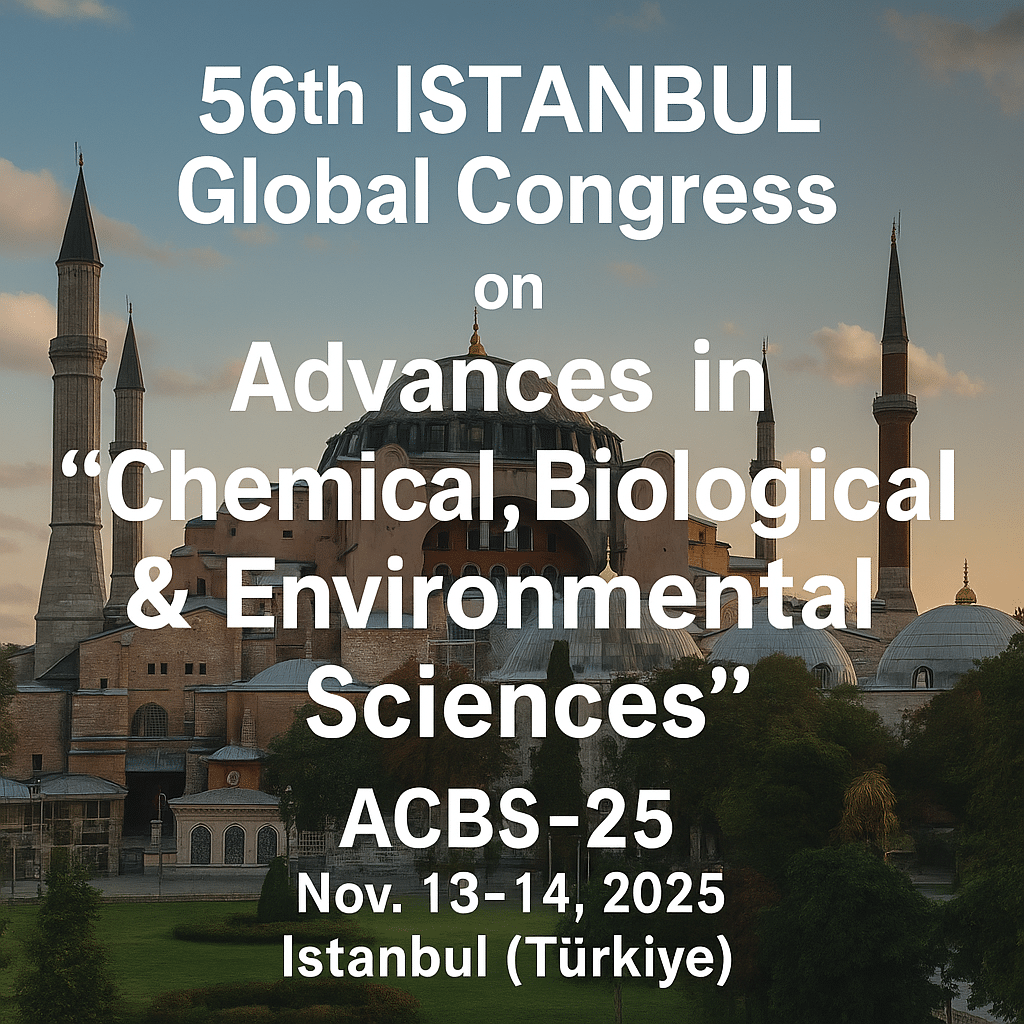
The idea of 56th ISTANBUL Global Congress on Advances in “Chemical, Biological & Environmental Sciences” (ACBS-25) scheduled on Nov. 13-14, 2025 Istanbul (Türkiye) is for the researchers, scientists, scholars, engineers and parctitioners from all around the world to present and share ongoing research activities. This conference provides opportunities for the delegates to exchange new ideas and application experiences face to face, to establish business or research relations and to find global partners for future collaboration. The conference is being organized by Dignified Researchers Publication (DiRPUB) operating under Pilares D’Elegancia LDA.
Full Articles/ Reviews/ Shorts Papers/ Abstracts are welcomed in the following research fields:
Chemical Sciences:
- Advanced Materials:
- Nanomaterials for environmental remediation and sensing
- Polymers for sustainable applications (biodegradable plastics, recycling technologies)
- Metal-Organic Frameworks (MOFs) and Covalent-Organic Frameworks (COFs) for catalysis, separation, and energy storage
- Supramolecular Chemistry and self-assembly
- Smart and responsive materials
- Catalysis:
- Homogeneous and heterogeneous catalysis for sustainable chemical processes
- Biocatalysis and enzyme engineering
- Photocatalysis for environmental cleanup and energy conversion
- Electrocatalysis for energy storage and conversion
- Analytical Chemistry:
- Advanced techniques for environmental monitoring and analysis (e.g., spectroscopy, chromatography, mass spectrometry)
- Development of new sensors for pollutants and biomolecules
- Data analysis and chemometrics in environmental and chemical studies
- Energy and Fuels:
- Renewable energy sources (solar, wind, biomass) and their chemical aspects
- Energy storage solutions (batteries, fuel cells)
- Carbon capture and utilization technologies
- Biofuels and bio-based chemicals
- Synthetic Chemistry:
- Development of new synthetic methodologies with reduced environmental impact
- Organocatalysis and metal-free catalysis
- Flow chemistry and continuous processes
- Medicinal chemistry and drug discovery with environmental considerations
Biological Sciences:
- Biotechnology and Genetic Engineering:
- CRISPR-Cas9 and other gene editing technologies for various applications
- Synthetic biology and the design of new biological systems
- Biopharmaceuticals and advanced drug delivery systems
- Metabolic engineering for biofuel and biochemical production
- Ecology and Biodiversity:
- Climate change impacts on ecosystems and species
- Conservation biology and strategies for biodiversity preservation
- Ecosystem services and their economic valuation
- Invasive species and their management
- Microbial ecology and its role in nutrient cycling and environmental processes
- Molecular and Cellular Biology:
- Advances in understanding cellular processes and signaling pathways
- Structural biology and its applications in drug design and biotechnology
- Genomics, proteomics, and metabolomics for understanding biological systems
- Neuroscience and the study of the nervous system
- Environmental Microbiology:
- Bioremediation of contaminated environments
- Microbial fuel cells and other bioenergy technologies
- The role of microorganisms in climate change and nutrient cycling
- Detection and control of waterborne and airborne pathogens
- Plant Science:
- Plant biotechnology for crop improvement and stress tolerance
- Plant physiology and responses to environmental changes
- Sustainable agriculture and plant-microbe interactions
Environmental Sciences:
- Pollution Control and Remediation:
- Water and wastewater treatment technologies
- Air pollution monitoring and control
- Soil contamination and remediation strategies
- Waste management and recycling technologies
- Emerging pollutants and their environmental fate and effects (e.g., microplastics, pharmaceuticals)
- Climate Change and its Impacts:
- Climate modeling and prediction
- Mitigation strategies (reducing greenhouse gas emissions)
- Adaptation strategies for dealing with the impacts of climate change
- Carbon sequestration and storage
- Climate policy and governance
- Water Resources Management:
- Water scarcity and drought management
- Water quality assessment and management
- Hydrology and the impact of land use change on water resources
- Integrated water resources management
- Ecology and Ecosystem Management:
- Ecosystem restoration and rehabilitation
- Conservation of natural habitats and protected areas
- Sustainable forestry and land management
- Urban ecology and green infrastructure
- Environmental Health:
- Impact of environmental pollutants on human health
- Exposure assessment and risk management
- Environmental justice and health disparities
- ????? between climate change and human health
Overarching Themes:
- Sustainability:
- Sustainable Chemistry and Green Chemistry Practices
- Sustainable Resource Management (water, energy, materials)
- Sustainable Agriculture and Food Production
- Environmental Sustainability and Ecosystem Preservation
- Sustainable Development Goals and the role of science
- Interdisciplinary Approaches: Topics that bridge the gaps between the three core sciences.
- Biogeochemical Cycles and their Anthropogenic Impacts
- Environmental Biotechnology and its Applications
- Chemical Ecology and Biological Interactions
- The Nexus of Water, Energy, and Food
- Systems-level understanding of environmental and biological processes
Emerging and Interdisciplinary Topics:
- Artificial Intelligence and Machine Learning in Environmental and Biological Sciences: For data analysis, modeling, and prediction.
- Remote Sensing and GIS for Environmental Monitoring and Management.
- Citizen Science and Public Engagement in Research.
- Ethics and Policy in Chemical, Biological, and Environmental Research.
- Education and Outreach in STEM fields.
0 Comments