
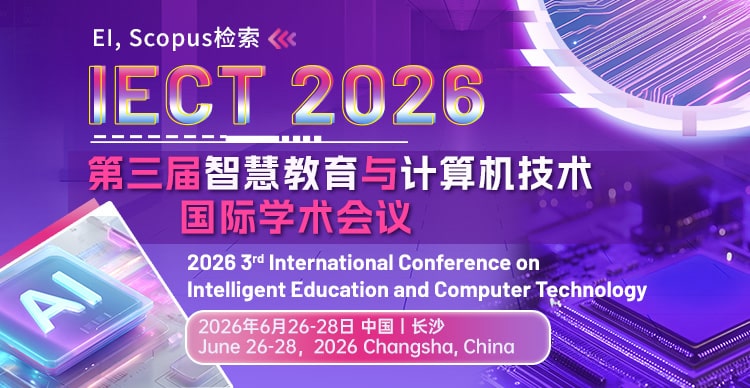
ABOUT IECT2026
With the development of computer science in recent years, our lives have been transformed, and significant changes have also been brought to the field of education. The development of intelligent education increasingly relies on the support of products and technology. In the modernization of education, new educational infrastructure includes modernized teaching facilities, large-scale network coverage, big data systems, and open educational resources. These hardware and software conditions are prerequisites for the transformation towards educational informatization.
The conference aims to bring together researchers, scholars, and practitioners in the field to discuss the latest research findings and technological innovations. The sessions will cover topics such as intelligent education, educational informatization, intelligent learning environments, and data mining. The conference seeks to meet the technological needs of education at all levels through technological innovation, accelerate the development and transformation of intelligent education, and create a truly sustainable new ecosystem for intelligent education. IECT 2026 is to bring together innovative academics and industrial experts in the field of Intelligent Education and Computer Technology to a common forum.
PUBLICATION
All accepted full papers will be published in the conference proceedings ACM International Conference Proceedings Series (ISBN: 979-8-4007-2365-0) and submitted to EI Compendex and Scopus for indexing after publication.
IECT 2024: ACM Digital Library| EI Compendex | Scopus
IECT 2025: ACM Digital Library| EI Compendex | Scopus
Note: All submitted articles should report original research results, experimental or theoretical, not previously published or under consideration for publication elsewhere. Articles submitted to the conference should meet these criteria. We firmly believe that ethical conduct is the most essential virtue of any academics. Hence, any act of plagiarism or other misconduct is totally unacceptable and cannot be tolerated.
ORGANIZER
Hunan Normal University
Call For Paper
Track 1: Learning Analytics and Educational Data Mining
Data-Informed Learning Theories
Learning and Teaching Processing Mining
Emotional Learning Analysis
Learner Engagement and Involvement Quantification and Analysis
Learning Early Warning and Learning Intervention
Design and Adoption of Learning Analytics Tools
Adaptive Learning Decision Support and Feedback
Multivariate and Multimodal Learning Assessment
Data-Driven Performance Prediction
Discourse analysis in Interactive Learning Environments
Collaborative Learning Analytics
Social and Epistemic Network Analysis
Ethical Issues in Learning Analytics
Track 2: Technology-Enhanced Learning and Instruction
Designing Interactive Virtual Reality (VR) Simulations for Science Education
Integrating Gamification Elements into Online/Offline Course Design
Utilizing Learning Analytics to Inform Instructional Design Decisions
Video Conferencing in Learning
Social Media Integration in Instruction
Digital Resources and Tools for Instruction
Interactive Simulations for Concept Teaching in STEM Education
Automated Grading Systems: Benefits, Challenges, and Best Practices
Personalizing Feedback to Support Student Learning
Technology-Enhanced Classroom Management Strategies
Digital Attendance Tracking and Student Progress Monitoring
Innovations in Technology Integration for Instruction
Interactive Whiteboards and Multimedia Presentations
Flipped Classroom Models
Integrating Robotics and Coding in STEM Instruction
Identifying At-Risk Students and Tailoring Support Interventions
Evidence-Based Instructional Decision Making
Track 3: Artificial Intelligence Enhanced Special Education
AI-based Assistive Technology for Special Children
AI-Powered Intervention Technology for Children with ASD
Intelligent Behavior Sensing for Special Children
AI-Assisted Assessment of Children with ASD
Brain Source Reconstruction for Mental Disorders
EEG Analysis for Special Children
Intelligent Screening for Children with ASD
Personalized Learning Techniques for Special Children
Human-Computer Interaction Technology for Special Education
Student Support Technology for Special Children
Intelligent Tutoring Systems for Special Education
Track 4: Artificial Intelligence Applications and Innovations in Education
Modelling and Representation of Individual and Group Learning
AI and the Future of Learning
Wearable and Undisturbed Learning Sensing Technologies
Affective Computing in Education
Generative AI in Education
AI-enabled Personalization Learning
Learning Content Recommendation
Intelligent Learning Environments
Human-AI Hybrid Systems for Learning
Intelligent Agent (Assistants)
Intelligent Tutoring Systems
Educational Process Visualization and Dashboard
AI-driven Transformation of Learning/Curriculum
AI Ethical, Privacy and Security Challenges in Education
0 Comments