
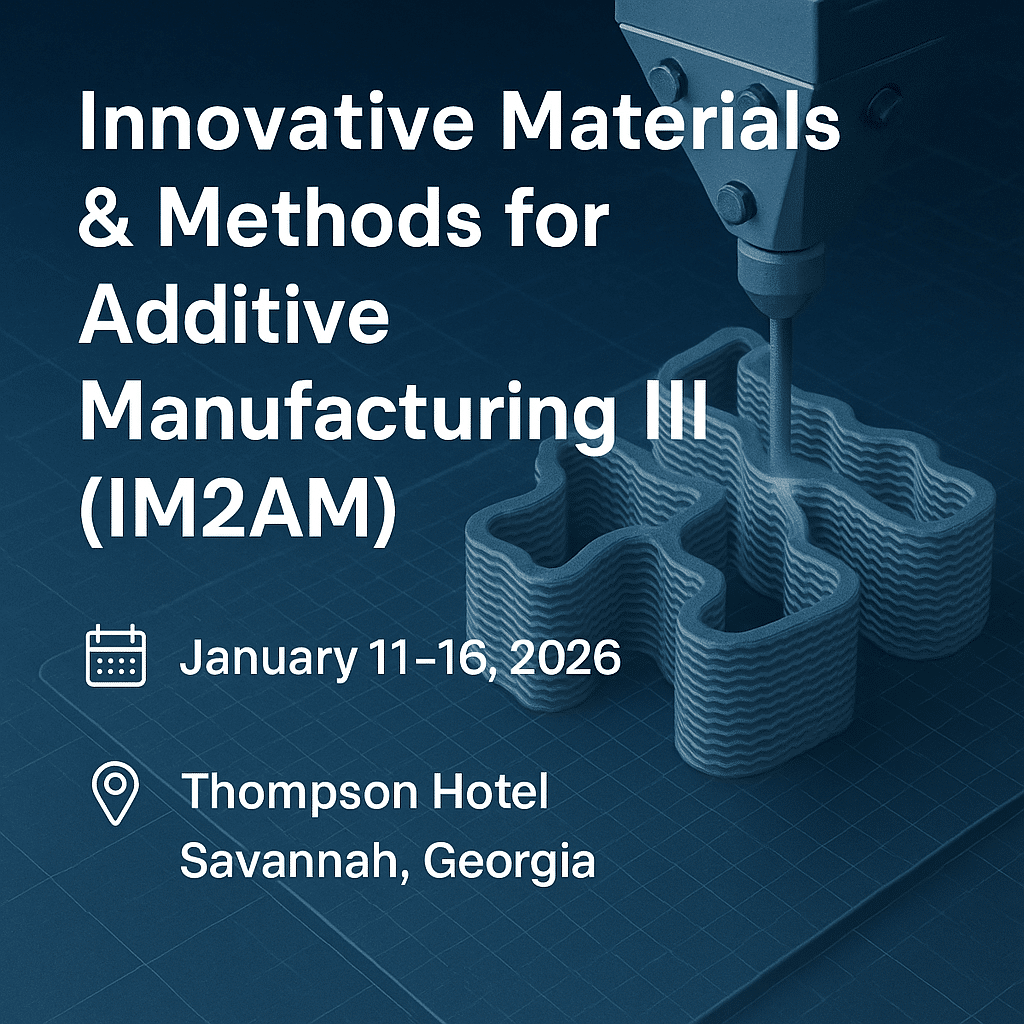
Additive Manufacturing (AM) has attracted substantial interest in recent times, promising a broad range of benefits. Of all aspects of AM, the development of new materials and the methods to make the best use of them are major priorities in this field. This is critically important because the products we rely on every day are manufactured using a huge variety of specialty material compositions. For example, a typical polymer part may contain pigments, plasticizers, toughening agents and reinforcement. Similarly, a metallic material may contain alloying elements for improved high temperature strength, corrosion and creep resistance, and a ceramic may contain dopants providing specific optical or dielectric properties. Currently, each new composition used in AM requires a significant development effort, and additive manufacturing processes are not always able to cope with the desired range of compositions. Likewise, while we have substantial freedom to alter the size and shape of parts, we lack robust design tools and process controls to design and define material properties and (multi)functionality within those parts with the same level of freedom, and to process such parts in a reliable and consistent fashion.
This conference will serve as a platform to bring together researchers and industrial practitioners with an interest in seeing these needs addressed in the context of AM through:
- New materials and materials development methodologies
- New ways of combining existing materials or incorporating local variations in properties
- New additive manufacturing methods that enable the translation of materials innovations into actual parts
- New developments related to design tools, process control, and metrology
The scope of the conference includes:
- Development of new polymers, metals, ceramics, composites, or bio-materials for AM
- Additive manufacturing methods enabling or taking advantage of materials innovations
- Characterization and validation of new materials for AM
- Generation, handling, and sharing of data to support development and characterization efforts
- Processing characteristics of new materials under AM-relevant conditions
- Optimization of AM parameters, post-processing and / or quality control
- Relations between properties of new AM-specific materials and parts prepared from them
- Approaches to the creation and characterization of hybrid / functionally graded parts
- Materials and process issues with strong relevance to hybrid / functionally graded parts (compatibility and interfacial bonding, fracture and fatigue, thermal expansion, etc.)
- Modeling, prediction and design of part properties based on materials characteristics
- Sustainable AM considering development of green materials for AM, end-of-life issues, resource recovery, and materials reuse
0 Comments